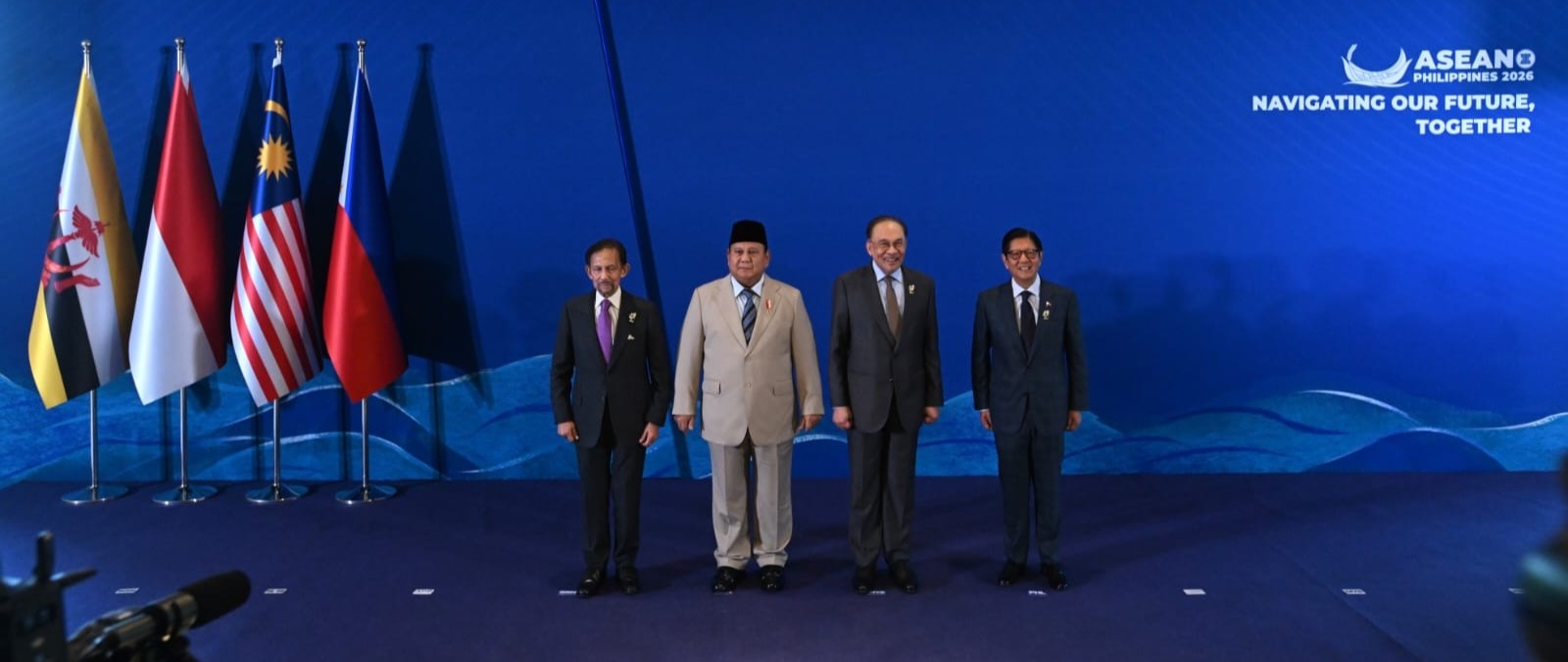
From left: Sultan Haji Hassanal Bolkiah and Yang Di-Pertuan of Brunei Darussalam, Indonesia President Prabowo Subianto, Malaysia Prime Minister Dato’ Seri Anwar Ibrahim, and Philippines President Ferdinand Romualdez Marcos.
The 10-year strategic roadmap seeks to enhance resilience and inclusive development for shared prosperity and sustainability.
BIMP-EAGA leaders adopted a 10-year strategic roadmap that will expand the subregion’s contribution to the ASEAN economy to at least 12% or an annual target of $720 billion, double the current average. Under BIMP-EAGA Vision (BEV) 2035, the subregion aspires to become a “Socially Inclusive, Open, Aligned and Resilient (S.O.A.R.) BIMP-EAGA for Shared Economic Prosperity and Sustainability.”
At the Special BIMP-EAGA Summit 2026 in Cebu, Philippines on 7 May, Sultan Haji Hassanal Bolkiah and Yang Di-Pertuan of Brunei Darussalam, Indonesia President Prabowo Subianto, Malaysia Prime Minister Dato’ Seri Anwar Ibrahim, and Philippines President Ferdinand Romualdez Marcos, Jr. stressed the importance of regional cooperation to enhance mutual resilience in the face of overlapping shocks.
“We noted that ongoing conflicts in the Middle East have added to global instability, with spillover effects on energy markets, food insecurity, trade flows, and inflationary pressures affecting our subregion,” they said in a joint statement. “In this context, we underscored that strengthened cooperation in energy resilience, food security, seamless digital connectivity and trade is more important than ever to enhance resilience, sustain growth, and safeguard shared development gains across BIMP-EAGA.”
ASEAN Secretary-General Kao Kim Hourn and Asian Development Bank (ADB) President Masato Kanda also attended the summit.
Developed with the support of ADB, BEV 2035 is expected to strengthen BIMP-EAGA’s “unique positioning as a unified growth area and unlock the subregion’s full economic potential” through four strategic outcomes:
- climate-smart agro-industry and fisheries that enhance food security while building climate resilience;
- seamless travel and sustainable tourism that balances growth with environmental and community stewardship;
- a network of production hubs that strengthens competitiveness, investment, and regional value chains; and
- an agile and future-ready workforce equipped to support digital, green, and blue economies.
“This vision is not merely a roadmap for economic integration. It is a promise to our people that development will be meaningful, sustainable, and felt in their daily lives,” said President Marcos in his opening statement as chair of the summit.
Targets under BEV 2035 include raising GDP per capita by more than 40% to $7,650, expanding trade in goods beyond $1.1 trillion over the next decade, increasing foreign and domestic investment inflows by 50% to an annual average of $300 billion, and boosting tourism receipts and expenditures by 10% every year.
Investments in regional connectivity continue to be important in achieving shared prosperity and inclusive development. As of April 2026, BIMP-EAGA’s rolling pipeline of priority infrastructure projects has increased to 265 projects, estimated to cost $174.6 billion, from 57 projects in 2017 when BIMP-EAGA Vision 2025 was adopted.
Key to the BEV 2035 strategy is the expansion and reconfiguration of economic corridors into integrated networks. Under the one growth area approach, four interlinked economic corridors will be developed to capture emerging opportunities. These are the West Economic Corridor, Central Economic Corridor, North–South Economic Corridor, and East Economic Corridor, a new corridor.
The leaders also reiterated the importance of aligning BIMP-EAGA with ASEAN Vision 2045. “We remain committed to align BIMP-EAGA efforts closely with ASEAN strategic priorities, serving as a complementary platform to advance ASEAN frameworks and initiatives in key areas, such as tourism, energy, agriculture and food security,” they said.