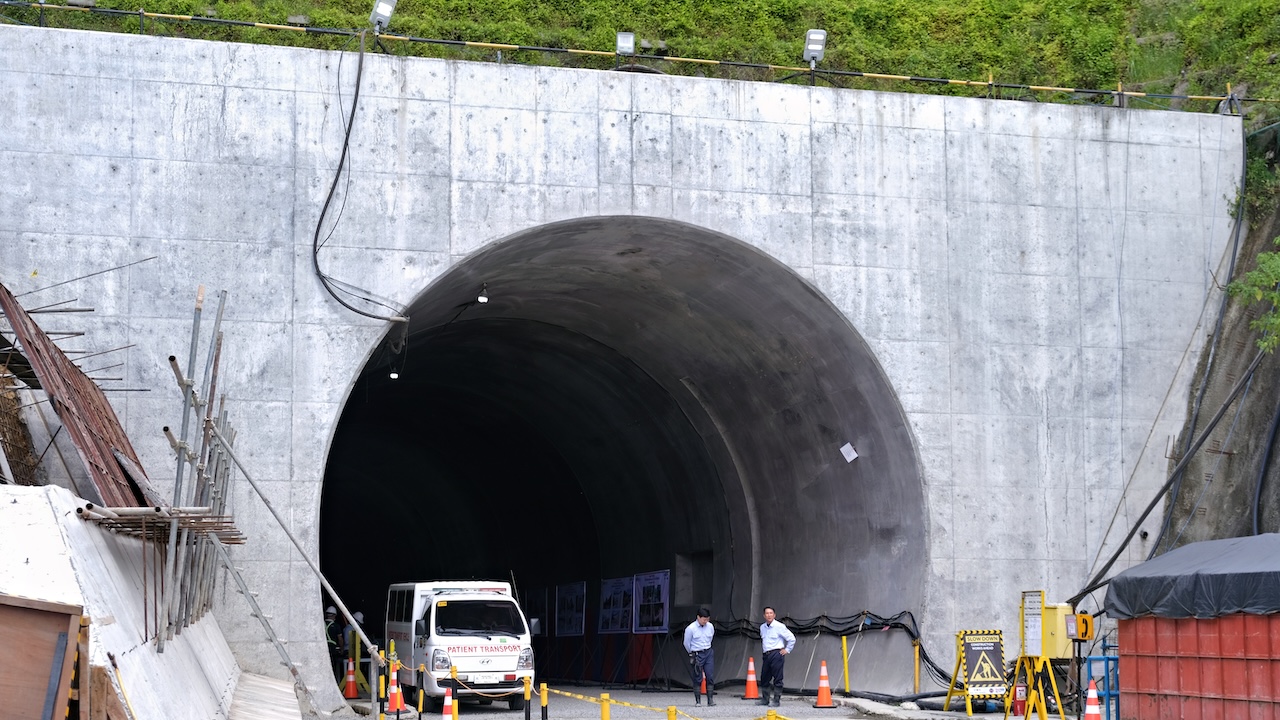
The project is expected to be completed next year. Photo credit: Courtesy of the Mindanao Development Authority.
The completion of a 45.5-kilometer bypass tunnel is expected to halve travel time between Digos City and Panabo City in the Davao Region to an estimated 49 minutes.
A priority infrastructure project of BIMP-EAGA in Mindanao, the bypass tunnel will not only improve mobility, but it is also expected to open economic corridors and create economic opportunities and jobs, particularly in manufacturing and agribusiness, by providing easier transport access to seaports and airports. It will also expand urban areas toward the inland areas with the new roads to be constructed.
The project involves the construction of a 29.7-km, 4-lane road, including bridges, and two 2.3-km tunnels, the first long-distance mountain tunnel in the Philippines. It will mitigate congestion in Davao City by diverting traffic to the bypass.
Most congested city
According to navigation technology firm TomTom’s Traffic Index 2024, Davao City is the most congested metropolitan area in the Philippines. Globally, it ranked eighth among the world’s slowest cities. According to the index, it takes 32 minutes and 59 seconds to travel just 10 km in Davao City. Due to the congestion, 136 hours are lost per year at rush hours in the city.
Expected to be completed next year, the project recently passed major milestones, with the completion of excavation for the northbound and southbound tunnels. According to the Mindanao Development Authority (MinDA), excavation for the southbound tunnel was completed in August, just 4 months after the northbound tunnel was completed.
The two tunnels are considered the longest in the country, overtaking the 300-meter Kaybiang Tunnel in Cavite. Their construction required advanced techniques, including the New Austrian Tunneling Method (NATM), which uses surrounding ground’s natural strength for support.
Improved connectivity and resilience
Civil works for the Davao City Bypass are now 61.1% complete, with the ₱46-billion project on track for full delivery by October next year. It will be fully operational by 2028. Civil works started in December 2020.
The project is being spearheaded by the Department of Public Works and Highways (DPWH) in partnership with the Japan International Cooperation Agency (JICA). It is part of the government’s “Build Better More” program, which aims to accelerate the development of climate-resilient infrastructure to support sustainable and inclusive growth.
Improving connectivity, like the Davao City Bypass project, is one of the pillars of BIMP-EAGA. In the last 8 years, BIMP-EAGA’s rolling pipeline of priority infrastructure projects has increased to 217, with 60 successfully completed and 157 projects in various stages of implementation. These projects include roads, railways and bridges, inland transport services, airports, seaports, power and energy infrastructure, information and communication technology, trade facilitation (including customs, immigration, quarantine, and security systems; economic zones; and industrial parks), and urban and border town development.