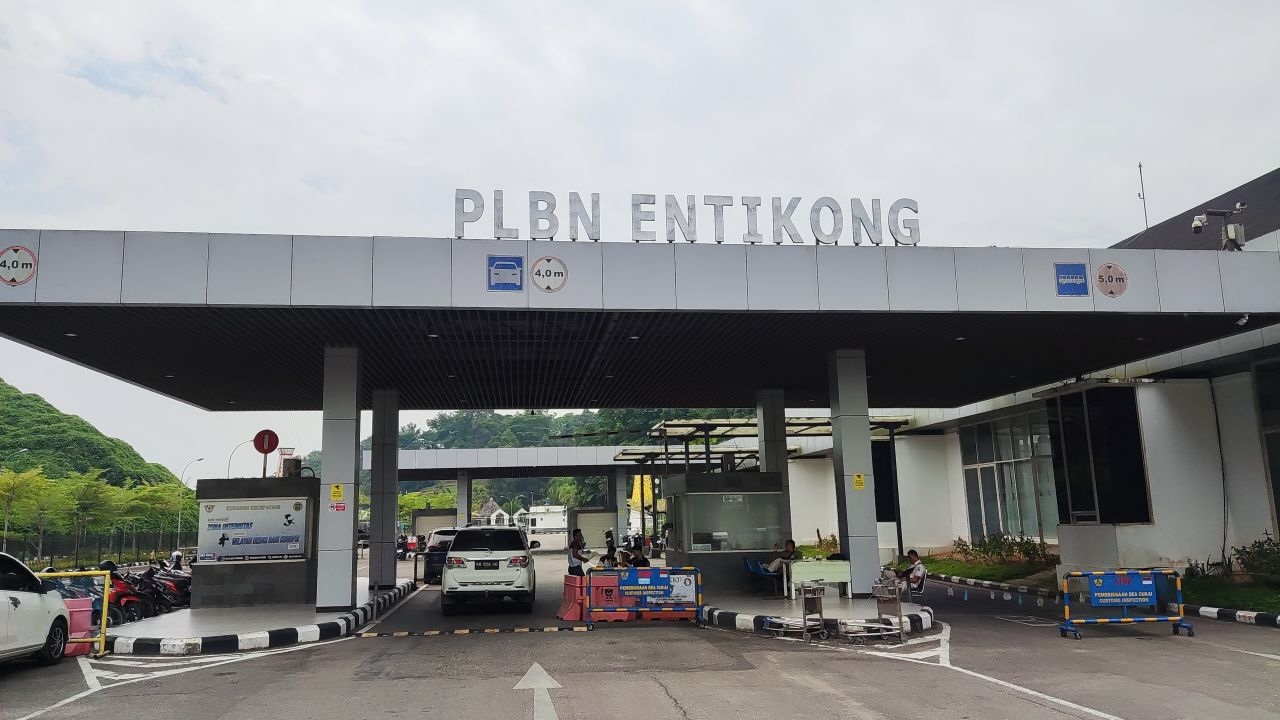
The push to introduce an online customs transit system in Kalimantan comes after Indonesia and Malaysia agreed to strengthen cross-border trade through Entikong–Tebedu. Photo credit: iStock/Ridham Supriyanto.
The launch next year of ASEAN’s online customs transit system in Kalimantan is expected to enhance trade between Indonesia and Malaysia and improve connectivity in Borneo. This is a welcome development for BIMP-EAGA as it would mean improved trade flows among member countries.
Once the ASEAN Customs Transit System (ACTS) is fully operational in Kalimantan, businesses will no longer need to make repeated customs declarations or change vehicles at every border in their route, easing movement of goods. ASEAN adopted the system to reduce transaction costs and to improve trade.
A report from news agency Antara said Indonesia is preparing the infrastructure to get the customs transit system up and running in Kalimantan. "We want to emphasize the importance of ensuring the availability of the necessary infrastructure, as well as the readiness of legal and procedural aspects, to support the smooth implementation of the Kalimantan ACTS Corridor,” it quoted Indonesia Deputy Minister of Trade Dyah Roro Esti Widya Putri as saying.
According to the ACTS portal, the routes designated for transit initially include the Pontianak–Entikong–Tebedu border crossing between Indonesia and Malaysia. Pontianak is the capital of West Kalimantan, while Entikong is a district in the province. Tebedu is a town in Sarawak.
In another report about the Kalimantan ACTS Corridor, Antara cited the growing cross-border trade between Jagoi Babang in West Kalimantan and Serikin in Sarawak. As of August 2026, the value of commodities traded across the route reached Rp109,40 billion ($10 million).
Boosting bilateral trade
The push to introduce an online customs transit system in Kalimantan comes after Indonesia and Malaysia agreed to strengthen cross-border trade through Entikong–Tebedu.
Trade through Entikong–Tebedu fell after Indonesia imposed restrictions on seven categories of goods entering Kalimantan through the crossing from May 2014.
But just last month, a media report said Indonesia President Prabowo Subianto and Malaysia Prime Minister Anwar Ibrahim agreed to boost trade flows through Entikong–Tebedu. The two countries are now working to resolve administrative issues.
A cornerstone of ASEAN integration
Customs transit is one of the cornerstones of ASEAN integration and of vital interest to the region’s businesses. It enables goods to move more freely and facilitates customs clearance formalities from point of departure through transit and ending at point of destination. It does so by temporarily suspending duties and taxes that are applicable to goods being imported into the region, or between the ASEAN members.
Introduced in phases starting 2020, ACTS facilitates the seamless movement of goods by land to enhance ASEAN’s trade and production networks. The system also establishes a more unified market for the region’s firms and consumers.
With a single digital customs transit declaration valid for the entire journey, traders no longer face repetitive inspections at each border. This reduces paperwork, shortens clearance times, lowers logistics costs, and ultimately makes regional trade faster, simpler, and more competitive.
Goods also move seamlessly between participating member states under a single guarantee that covers all duties and taxes at risk.
For governments, ACTS strengthens cooperation between customs and transport agencies, ensuring that cross-border trade is efficient and well-facilitated.
ACTS is a key initiative under the ASEAN Framework Agreement on the Facilitation of Goods in Transit, which seeks to make the cross-border movement of goods smoother, faster, and more efficient among ASEAN countries by creating a common legal and operational framework for transit transport.
A boost to BIMP-EAGA’s corridor strategy
ASEAN’s efforts to ease the movement of goods via a customs transit system aligns with BIMP-EAGA’s vision to improve connectivity in the subregion and supports its economic corridor strategy to spread the benefits of development to marginalized areas and contribute to sustainable and inclusive growth.
West Kalimantan is part of BIMP-EAGA’s West Economic Corridor, which is designated as the subregion’s oil and gas economic corridor. It encompasses all four BIMP-EAGA countries. Specifically, it includes Belait, Brunei-Muara, Temburong, and Tutong; West Kalimantan; Federal Territory of Labuan, Sabah, and Sarawak; and Basilan, Palawan, Sulu, Tawi-Tawi, Zamboanga del Norte, Zamboanga del Sur, and Zamboanga Sibugay.
Apart from opportunities in the oil and gas sector, the corridor has potential to be a transport and logistics corridor. There are also opportunities in light manufacturing, palm oil and wood-based processing, tourism, renewable energy development, and carbon capture, use, and storage.
The BIMP-EAGA economic corridors are envisioned to function as a network. The corridors are interlinked and not delimited by geography. They are influenced by wide-ranging factors to expand functional economic areas. Over time, it is expected that more overlaps or interlinks across corridors will develop as the subregion moves toward becoming one seamless BIMP-EAGA growth area.