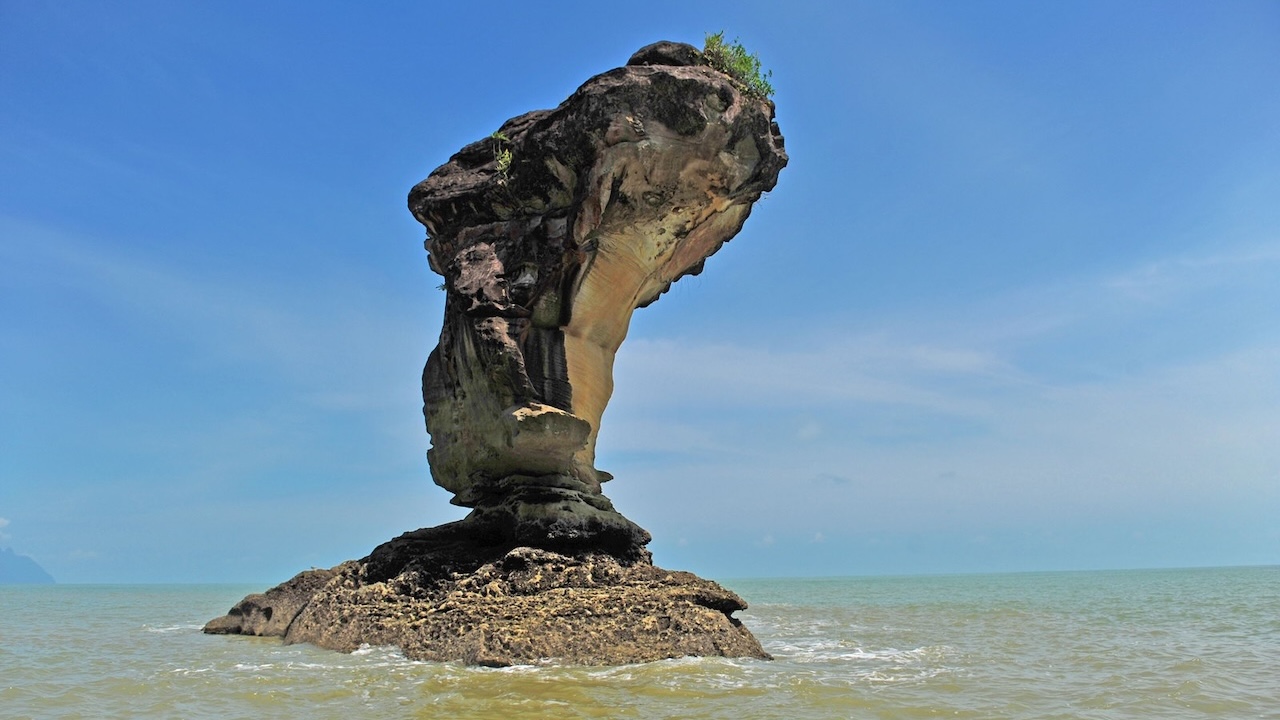
A sea stack rock formation at the Bako National Park. Photo credit: Courtesy of the Sarawak Tourism Board.
BIMP-EAGA now boasts of 16 protected areas that have been declared as ASEAN Heritage Parks, highlighting the ecological importance of the subregion.
Bako National Park and Lambir Hills National Park in Sarawak, Malaysia were added to the ASEAN Heritage Park network during the 18th ASEAN Ministerial Meeting on the Environment in Langkawi, Malaysia in September 2025. This is the second year in a row that protected sites in BIMP-EAGA were recognized under the program. In 2024, Turtle Islands Wildlife Sanctuary in Tawi-Tawi, Philippines was added to the network.
The ASEAN Heritage Park program was created to protect areas of high conservation importance to Southeast Asia. These parks encompass terrestrial and aquatic ecosystems that support endemic and endangered flora and fauna.
Bako National Park
Although relatively small at only 2,727 hectares, Bako National Park is rich in biological biodiversity. It is known for its sandstone plateau formation and the Kerangas Forest, which has diverse vegetation types.
The park has around 600 species of flowering plants, many of which are native to Borneo. It is also home to 19 globally threatened species of fauna including 12 species of mammals—five of which are listed in the IUCN Red List of Threatened Species. The park provides habitat for the proboscis monkey (Nasalis larvatus), a species endemic to Borneo, as well as the bearded pig (Sus barbatus).
The park is part of Bako-Buntal Bay, which is among the internationally recognized conservation sites for birds. It is also part of the East Asian–Australasian Flyway, one of the world’s nine great flyways for migratory waterbirds. The park’s marine area also encompasses migratory routes for marine turtles.
Lambir Hills National Park
Lambir Hills National Park is located in the coastal city of Miri, northern Sarawak. It is characterized by pristine rainforests and rugged terrain, various escarpments, and waterfalls. The park is an important bird area and has been designated as one of the global centers of plant diversity and endemism since it has more endangered tree species than any other park in Sarawak and possibly in all of Southeast Asia.
The park is home to the great argus (Argusianus argus), banded-leaf monkey (Presbytis melalophos), red-leaf monkey (Presbytis rubicunda), western tarsier (Tarsius bancanus), and eight hornbill species (Anorrhinus galeritus, Anthracoceros albirostris, Anthracoceros malayanus, Berenicornis comatus, Buceros rhinoceros, Rhabdotorrhinus corrugatus, Rhinoplax vigil, and Rhyticeros undulatus).
The plant diversity at the park is believed to be the richest of all Malaysian forest types, with diverse fig flora, which accounts for more than half of all fig species in Borneo.
Turtle Islands Wildlife Sanctuary
The Turtle Islands Wildlife Sanctuary is located in the southwestern tip of the Philippines and is part of the Sulu archipelago in the municipality of Tawi-Tawi. It is characterized as a rocky islet that spans six islands. It is under the jurisdiction of the Ministry of Environment, Natural Resources and Energy of the Bangsamoro Autonomous Region in Muslim Mindanao.
The wildlife sanctuary is the only major nesting habitat of green sea turtles (Chelonia mydas) in the Philippines and the only one in the ASEAN region. There are 281 flora species reported in the Turtle Islands, and based on government records, there are 414,529 nests of green turtles and hawksbill turtles recorded in the park for the past 29 years with an average of 13,817 per year.
Turtle Islands is classified as Extremely High for biodiversity conservation. It is part of the Turtle Islands Heritage Protected Area, the first transboundary protected area for marine turtles in the world, which was created through a memorandum of agreement between Malaysia and the Philippines in 1996. Turtle Islands is also a member of the Indian Ocean and South-East Asia Marine Sea Turtle Site Network. This marine sanctuary is a premier ecotourism destination where visitors can engage in ecotourism activities like turtle watching, scuba diving, snorkeling, birdwatching, and nature walks through pristine coastal forests and mangroves.
Flagship program
In total, there are now 69 ASEAN Heritage Parks, a flagship program that serves as the cornerstone of biodiversity conservation in Southeast Asia.
According to the ASEAN Centre for Biodiversity, the program aims to protect and restore the region’s shared natural heritage. The center serves as the secretariat of the program and facilitates the evaluation process of the nominated protected areas to be declared. The center also coordinates among the parks for their enhanced management and operations through knowledge sharing, capacity building, international support, partnerships, and raising public awareness.
The other BIMP-EAGA protected areas in the ASEAN Heritage Park network are the Tasek Merimbun Heritage Park in Brunei Darussalam; the Bantimurung–Bulusaraung National Park, Wakatobi National Park, and Lorentz National Park in Indonesia; Gunung Mulu National Park and Kinabalu National Park in Malaysia; and Mt. Apo Natural Park, Mt. Hamiguitan Range Wildlife Sanctuary, Mt. Kitanglad Range NaturaI Park, Mt. Malindang Range Natural Park, Mts. Timpoong–Hibok-Hibok Natural Monument, Agusan Marsh Wildlife Sanctuary, and the Tubbataha Reefs Natural Park in the Philippines.