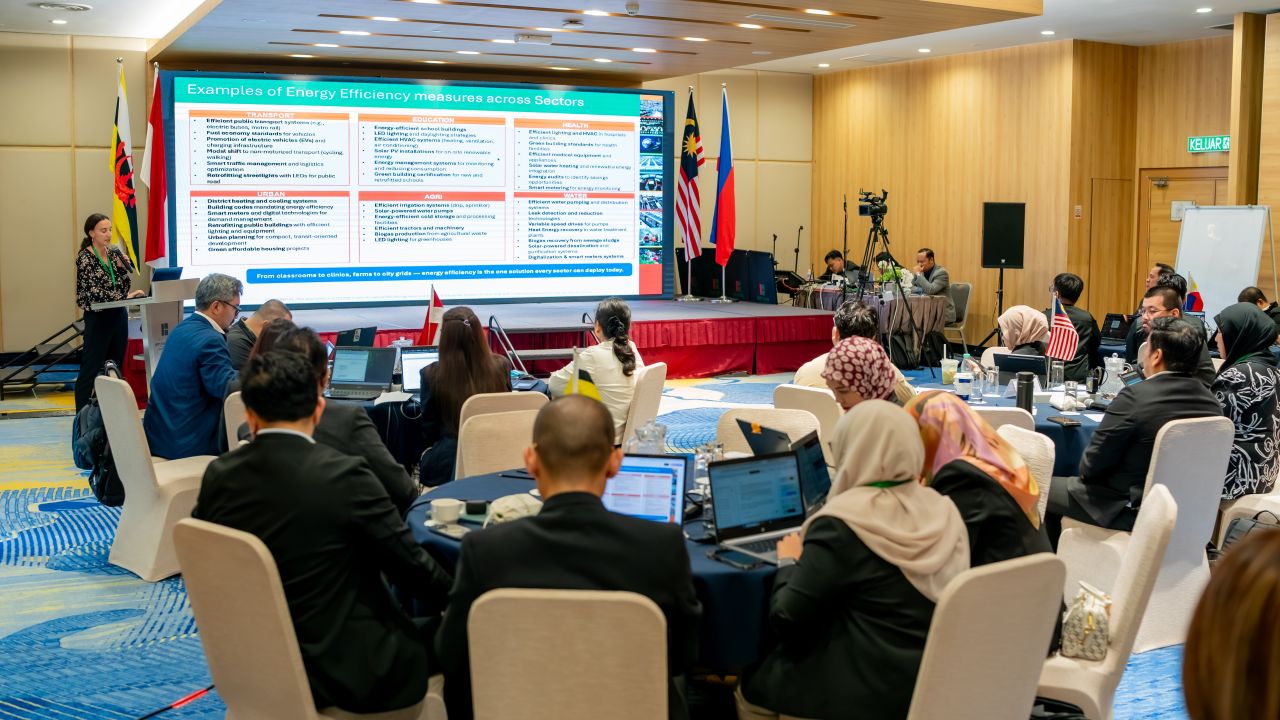
Supported by the Asian Development Bank (ADB) in collaboration with the ASEAN Centre for Energy (ACE), BIMP-EAGA Power, Energy and Infrastructure Cluster (PEIC), and the Ministry of Energy and Environmental Sustainability Sarawak, the one-day activity brought together policymakers, development partners, and technical experts from energy agencies, regulators, and utilities.
At a workshop in Bintulu, Sarawak, BIMP-EAGA policymakers and regulators explore opportunities to deepen cooperation in energy efficiency and conservation.
BIMP-EAGA countries are looking at ways to save energy by reducing consumption and improving efficiency. Under its 10-year Vision 2035 strategic road map, the subregion plans to scale up clean energy initiatives as it shifts to low-carbon development.
Energy efficiency and conservation offer a practical and cost-effective means of reducing carbon emissions while boosting productivity and economic growth. Lower energy demand can also defer investments in additional generation and network capacity and strengthen resilience to energy price and supply shocks.
To support the implementation of BIMP-EAGA Vision 2035, a workshop on energy efficiency and conservation was organized in Bintulu, Sarawak. Supported by the Asian Development Bank (ADB) in collaboration with the ASEAN Centre for Energy (ACE), BIMP-EAGA Power, Energy and Infrastructure Cluster (PEIC), and the Ministry of Energy and Environmental Sustainability Sarawak, the one-day activity brought together policymakers, development partners, and technical experts from energy agencies, regulators, and utilities. Some participants joined the workshop online.
All four BIMP-EAGA countries—Brunei Darussalam, Indonesia, Malaysia, and the Philippines—have energy efficiency and conservation policies and programs but at different stages of development and implementation. Exchanging knowledge and experiences can help address common implementation challenges, bridge gaps in capacity and financing, and develop markets for energy service companies, which play a key role in increasing energy efficiency.
As a building block of ASEAN integration, BIMP-EAGA can serve as a platform for testing and showcasing cooperation in energy efficiency and conservation in Southeast Asia. Most of the countries in the region rely heavily on oil and gas imports, making them vulnerable to surging fuel prices and supply disruptions.
Resource speakers at the workshop included experts from ACE, ADB, the International Energy Agency (IEA), and the private sector.
Reining in demand
Natalie Kauf, energy analyst at IEA, said the demand for electricity in Southeast Asia has grown faster than overall energy demand at 6% a year since 2015, nearly twice the global average.
According to IEA’s Southeast Asia Energy Outlook 2026, buildings and industry are driving the surge in electricity demand. “Electricity use for cooling has doubled over the past decade, the fastest growing established use of electricity in the region,” Kauf said.
Improving energy efficiency in industry and transport, the largest energy users in the ASEAN region, can deliver savings of up to 31% and 39% by 2050 based on potential outcomes of national policies, said Mardika Firlina, technical officer at ACE’s Energy Efficiency and Conservation Department. These two sectors are still powered largely by fossil fuels.
“The building sector, meanwhile, offers notable savings through mature, readily available technologies,” she said. These include energy-efficient lighting and appliances, such as air-conditioning and refrigeration systems. Energy demand of residential and commercial users could fall by 23% and 34% by 2050.
Firlina noted the growing trend toward sector-wide initiatives in energy efficiency and conservation in the region.
Designing bankable projects
One of the challenges in advancing energy efficiency is developing a pipeline of bankable projects.
Florence Ventura, energy specialist at ADB, explained that an energy audit is the starting point for developing bankable energy efficiency projects. It establishes how energy is consumed, identifies potential savings, and supports a financially viable action plan. A data-driven energy management system aligned with ISO 50001 can then track results and help sustain measurable improvements in performance.
High-quality, verifiable data is needed to participate in carbon trading markets.
Ventura identified opportunities to strengthen regional cooperation “through shared audit methodologies, capacity building on energy management and MRV [monitoring, reporting, and verification], and the development of a pipeline of bankable energy efficiency projects.” Smaller cooling, industry, and building projects may be aggregated into investable portfolios, helping them reach the scale needed to attract financing.
She underscored the need to “align audit and baseline practice across countries.” She said comparable methods would allow participating countries and financiers to assess savings consistently, verify performance, and aggregate projects across markets.
Cooperation initiatives
There are also opportunities for cooperation under the joint plan of action for 2026 to 2030, which aligns the priorities of subregional programs—BIMP-EAGA, the Greater Mekong Subregion, and the Indonesia–Malaysia–Thailand Growth Triangle with the ASEAN Community Vision 2045 and its strategies.
At the workshop, Pamela Asis-Layugan, regional cooperation specialist at ADB’s Southeast Asia Department, discussed potential areas for subregional collaboration in energy efficiency and conservation, which is a priority under the joint plan of action.
Opportunities include capacity building for energy transition, technology, innovation, and green finance.
Related ASEAN initiatives include the ACE-led Sustainable ASEAN Energy Management Scheme, which seeks to establish a regional energy manager certification system that complements existing national schemes, enables cross-border professional mobility, enhances energy efficiency, and contributes to achieving carbon neutrality.
Priorities for BIMP-EAGA
The breakout group discussions at the workshop identified limited access to financing and incentives as the main barrier to implementing energy efficiency projects.
Priorities identified during the discussions included improving access to affordable funding and subsidized energy audits; strengthening technical capacity and public awareness; and advancing regional cooperation through a dedicated BIMP-EAGA fund, common standards and performance metrics, and a knowledge-sharing platform.
Alignment with the ASEAN Plan of Action for Energy Cooperation (APAEC) 2026–2030 can also strengthen the contribution of BIMP-EAGA initiatives to wider ASEAN priorities.
Workshop outputs and recommendations will feed into the development of a shared agenda on energy efficiency and conservation in BIMP-EAGA.