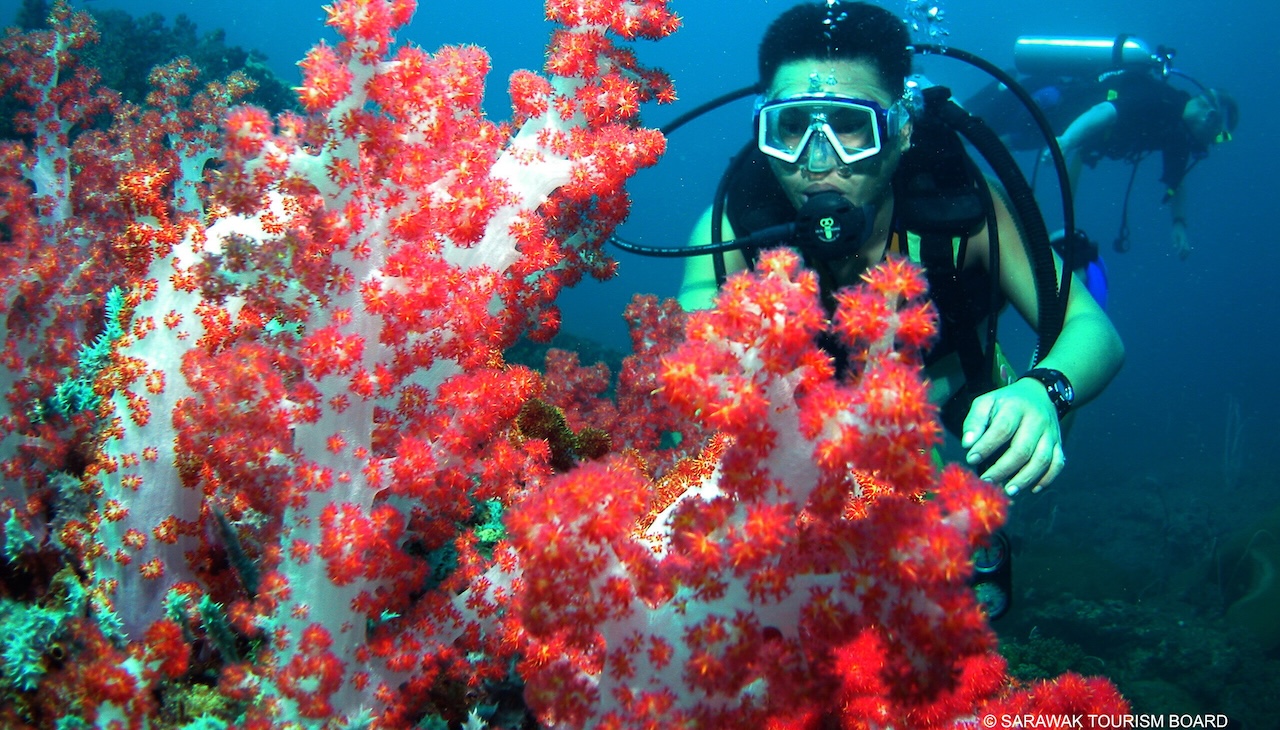
BIMP-EAGA's tourism attractions include diving in Sarawak. Photo credit: Courtesy of the Sarawak Tourism Board.
Subregional cooperation programs in Southeast Asia play a critical role in advancing intra-ASEAN tourism, with the platforms helping facilitate cross-border travel, marketing, and infrastructure coordination.
With the recently launched ASEAN Tourism Sectoral Plan 2026–2030, the regional bloc commits to further enhancing collaboration with subregional programs to maximize the shared benefits from advancing sustainable, inclusive, responsible, and high-quality tourism development in Southeast Asia. The plan seeks to stimulate intra-ASEAN travel, attract responsible and resilient investment, and strengthen capacity in crisis preparedness and response.
At present, tourism cooperation in ASEAN is shaped by four key subregional programs. These are the Brunei Darussalam–Indonesia–Malaysia–Philippines East ASEAN Growth Area (BIMP-EAGA); the Indonesia–Malaysia–Thailand Growth Triangle (IMT-GT); the Greater Mekong Subregion (GMS), which groups Cambodia, the Lao People’s Democratic Republic (Lao PDR), Myanmar, Viet Nam, and Yunnan Province and Guangxi Zhuang Autonomous Region in the People’s Republic of China; and the Ayeyarwady–Chao Phraya–Mekong Economic Cooperation Strategy.
With Southeast Asia welcoming an estimated 144 million international visitors in 2025, a 13.4% increase from the previous year, the region seeks to grow tourism not just in terms of visitor numbers but also the quality of offerings from each country.
In opening the ASEAN Tourism Conference 2026 in Cebu, Philippines in January, ASEAN Deputy Secretary-General Satvinder Singh highlighted the role of collaboration as the region rolls out the roadmap to ensure the sector’s quality growth.
Along with the roadmap, the region also developed the ASEAN Tourism Marketing Strategy 2026–2030, which provides a unified framework for promoting Southeast Asia as a competitive, responsible, and world-class tourism destination in consumer-facing media, such as social media, websites, and the news press.
“This strategy for marketing positions our region effectively as a diverse, connected, competitive, multi-country destination,” said Singh. He said the marketing strategy will help define how ASEAN is presented to the world through data-driven marketing, digital engagement, and strategic partnerships.
He said the two strategies complement each other, with the implementation requiring collaboration not just among ASEAN member states and national tourism organizations, but also the private sector, development partners, and the subregional groupings. “It [tourism agenda] will reflect, really, our shared ownership, a collective understanding that ASEAN tourism truly depends on collaboration across borders and across sectors.”
Subregional platforms as implementors and incubators
Over the years, subregional initiatives implemented projects and initiatives that complement ASEAN-wide priorities by facilitating multi-country tourism circuits, promoting secondary and emerging destinations, and fostering more balanced and inclusive tourism growth across member states.
The initiatives aligned with the strategic directions of the ASEAN Tourism Strategic Plan through 2025. These include development of cross-border tourism routes, joint marketing campaigns, transport infrastructure upgrades, and the promotion of ecotourism, community-based tourism, and streamlined visa processes. Collectively, these efforts enhance regional connectivity and work toward seamless intra-ASEAN travel.
In BIMP-EAGA, for instance, major efforts have focused on upgrading airports and seaports to improve access to remote areas, promoting eco- and adventure tourism—particularly in Borneo—and encouraging private sector participation in sustainable tourism development.
In the GMS, infrastructure projects such as the East-West Economic Corridor and the Southern Economic Corridor have supported cross-border mobility among Cambodia, the Lao PDR, Myanmar, Viet Nam, and Thailand. Tourism offerings have expanded to include self-drive tourism, ecotourism, and cultural heritage experiences, anchored in 14 multi-country tourism clusters, such as the Mekong Discovery Trail, a community-based ecotourism initiative.
Similarly, IMT-GT has promoted multi-destination tourism packages and leveraged its shared cultural and natural heritage, including the UNESCO World Heritage Sites, to strengthen cross-border collaboration.
In implementing these initiatives, subregional programs effectively served as incubators for pilot projects—a role the plan sees the subregional platforms continuing to play in testing cross-border circuits, community-based models, and micro, small and medium-sized enterprise initiatives for scaling across the region.
Essential marketing partner
Both the tourism roadmap and the marketing plan consider the subregional programs as critical partners in helping ASEAN amplify its brand through targeted, multi-country campaigns. The subregional groups, in fact, were consulted on developing both documents, along with other stakeholders.
The marketing plan said ASEAN should collaborate with BIMP-EAGA, GMS, and IMT-GT to design and implement coordinated multi-country marketing campaigns, including developing shared campaign calendars. These partnerships help align tourism promotion with regional development goals and maximize shared resources.
By highlighting unique subregional experiences—like cultural heritage trails, adventure tourism, wellness retreats, and Muslim-friendly travel—ASEAN can present Southeast Asia as a connected, diverse destination that encourages visitors to explore multiple countries in one trip.
The plan outlined specific tourism products and circuits that each subregion can promote.
For BIMP-EAGA, the marketing plan identified the Coral Triangle diving circuit, Borneo rainforest and wildlife experiences, sustainable island‑hopping cruises, and cross‑border cultural trails.
For GMS, the marketing plan identified Mekong River multi-country cruises, UNESCO heritage trails (Angkor–Bagan–Hue–Sukhothai), Golden Triangle adventure tourism, and eco‑wellness tourism in Mekong cities.
For IMT‑GT, the plan identified Muslim‑friendly and halal tourism circuits, wellness and medical tourism hubs, cross‑border culinary trails, and luxury and business travel routes.
The marketing plan also emphasized sharing resources and amplifying reach through joint campaigns in key markets, working closely with ASEAN Centres in Japan, the People’s Republic of China, and the Republic of Korea. It also noted the importance of leveraging local expertise for language and cultural adaptation, targeted audience engagement, and on-the-ground promotions. These help ensure marketing campaigns across diverse source markets are relevant and effective.