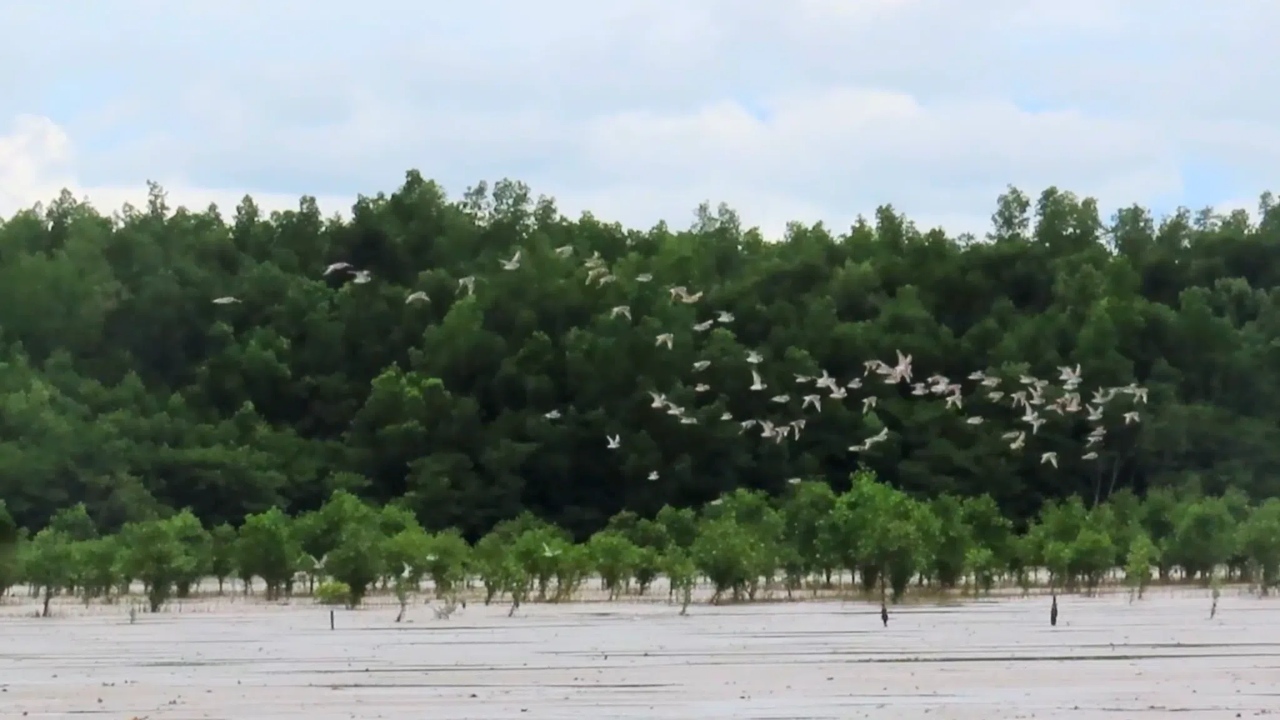
Sibugay Wetland Nature Reserve in Zamboanga Sibugay province in the Philippines. Photo credit: Asian Development Bank.
Their inclusion brings the total number of flyway network sites in BIMP-EAGA to six.
Three wetlands in Mindanao were recently recognized as internationally important to migratory waterbirds along the East Asian–Australasian Flyway. This brings the total number of flyway network sites in the Philippines to seven and in BIMP-EAGA to six. These sites provide the birds a place where they can rest and eat. However, they face habitat loss due to a combination of factors, including climate change, pollution, sea and land-use conversion, sea-level rise, illegal mining, deforestation, and droughts.
The newly designated sites in the Philippines are Lake Mainit, Agusan Marsh Wildlife Sanctuary, and Sibugay Wetland Nature Reserve.
The East Asian–Australasian Flyway is one of the world’s nine flight paths for migratory birds and the most threatened. A large-scale transboundary program led by the Asian Development Bank (ADB), the East Asian–Australasian Flyway Partnership (EAAFP), and BirdLife International aims to mobilize $3 billion in investments in over 10 years to protect, restore, and sustainably manage a network of threatened natural wetlands across 11 developing countries in Asia and the Pacific. Launched in 2021, the Regional Flyway Initiative covers mangrove forests, peatlands, marshes, tidal mudflats, and coral atolls along the flyway.
Lake Mainit is located within the Mt Hilong-Hilong Key Biodiversity Area and lies on the border of Surigao del Norte and Agusan del Sur provinces in northeastern Mindanao. It is the fourth largest and deepest lake in the Philippines, covering nearly 14,000 hectares. A high number of migratory waterbirds, exceeding 50,000 in some years, use the lake as a key feeding and stopover site. These include the Little Egret (Egretta garzetta), Wandering Whistling Duck (Dendrocygna arcuata), and Tufted Duck (Aythya fuligula). EAAFP says Lake Mainit supports more than 1% of the Tufted Duck’s global population.
The Agusan Marsh Wildlife Sanctuary is a protected area in Agusan del Sur. It offers “abundant feeding grounds and secure roosting areas” for more than 20,000 waterbirds of migratory species, such as the Little Egret, Intermediate Egret (Ardea intermedia), Marsh Sandpiper (Tringa stagnatilis), and Whiskered Tern (Chlidonias hybrida).
The Sibugay Wetland Nature Reserve in Zamboanga Sibugay province supports a wide diversity of shorebirds and waterbirds. These include four endangered species—the Far Eastern Curlew (Numenius madagascariensis), Great Knot (Calidris tenuirostris), Siberian Sand Plover (Charadrius mongolus), and Black-faced Spoonbill (Platalea minor).
The four other designated flyway network sites in the Philippines are Naujan Lake National Park in Oriental Mindoro province and Tubbataha Reef Marine Park in Palawan province, which are both in Luzon, and Olango Island Wildlife Sanctuary in Cebu province and Negros Occidental Coastal Wetlands Conservation Area in the Visayas.
Twice a year, the birds travel along the flyway between their breeding grounds in the northern part of the People’s Republic of China and Russia to their wintering sites in Southeast Asia and Australia.
The habitats along the flyway benefit not just the birds but also other species, including humans. They serve as a carbon sink and help mitigate climate impacts. They also protect coastal communities from the impacts of flooding, sea level rise, and storm surges.
Philippines Flyway Project
In November, ADB launched the Philippines Flyway Project, which will strengthen the conservation of Lake Mainit and Sibugay Wetland Nature Reserve as well as Candaba Wetlands in Luzon. The project is part of the Regional Flyway Initiative and was announced at the 12th Meeting of Partners of the East Asian–Australasian Flyway Partnership, which was hosted by the Philippines. It is funded by a $3 million grant from the Global Environment Facility.
The Philippines Flyway Project aims to protect and sustainably manage wetlands that serve as critical stopovers for migratory birds traveling along the East Asian–Australasian Flyway while also enhancing biodiversity, supporting sustainable livelihoods, and boosting climate resilience for millions of Filipinos. “Wetlands in our region face mounting threats from reclamation, degradation, and urban expansion, and the EAAF is considered the most threatened of the world’s major flyways,” said ADB Vice-President for East and Southeast Asia, and the Pacific Scott Morris. He said ADB is working with the Philippines’ Department of Energy and Natural Resources (DENR) “to protect, manage, and restore these critical ecosystems—helping communities and nature thrive.”
The project will build local capacity and enhance site management plans.
Meanwhile, ADB is also assessing the potential for nature and carbon credits at nine coastal wetlands sites in the Philippines under the Regional Flyway Initiative.
Other sites in the subregion
BIMP-EAGA has three other ecologically important sites included in the East Asian–Australasian Flyway Network.
The Tubbataha Reef Marine Park in Palawan, Philippines is an atoll reef. Its North Islet is a nesting site for birds and marine turtles. According to EAAFP, the marine park is the only known breeding area in Southeast Asia of the “subspecies of Black Noddy (Anous minutus worcestri), one out of about four major remaining breeding areas of Sooty Tern (Onychoprion fuscatus) and Brown Noddy (Anous stolidus), and the last known breeding area of Masked Booby (Sula dactylatra) in the Philippines until 1995.” Migratory species recorded at the site include the critically endangered Christmas Island Frigatebird (Fregata andrewsi), the Chinese Egret, Swinhoe's Storm Petrel (Oceanodroma monorhis), Eurasian Curlew (Numenius arquata), and Blacktailed Godwit (Limosa limosa).
The Wasur National Park, dubbed as the "Serengeti of Papua," is part of the largest wetland in Merauke Regency in South Papua at the eastern tip of Indonesia. Some 424 species of birds were sighted at the park. These include 74 species endemic to Papua and 114 species protected by the Government of Indonesia.
Located in the state of Sarawak, Bako-Buntal Bay is Malaysia's first flyway network site under EAAFP. It provides food and shelter to at least 20,000 migratory shorebirds from 32 species, including globally threatened species such as Nordmann’s Greenshank (Tringa guttifer), Great Knot, Chinese Egret (Egretta eulophotes), and Far Eastern Curlew.