Transport
To become fully integrated, BIMP-EAGA needs an efficient and secure transport network that seamlessly moves goods and people within and across borders. Interconnecting the subregion by land, air, and water also opens livelihood opportunities in rural communities and improve their access to services.
The BIMP-EAGA Transport Cluster aims to create a reliable, safe, resilient, efficient, and sustainable multimodal transport network that strengthens connectivity, fosters inclusive socioeconomic development, and facilitates seamless travel across the subregion.
In line with its high growth aspirations under BIMP-EAGA Vision 2035 and ASEAN’s pursuit of greater economic integration, BIMP-EAGA seeks to further advance the transport connectivity agenda to enhance cross-border trade, tourism, investments, logistics, and social mobility.
The new transport strategy is anchored on a holistic approach, ensuring that transport systems provide the means for economic transformation that fosters environmental and social gains.
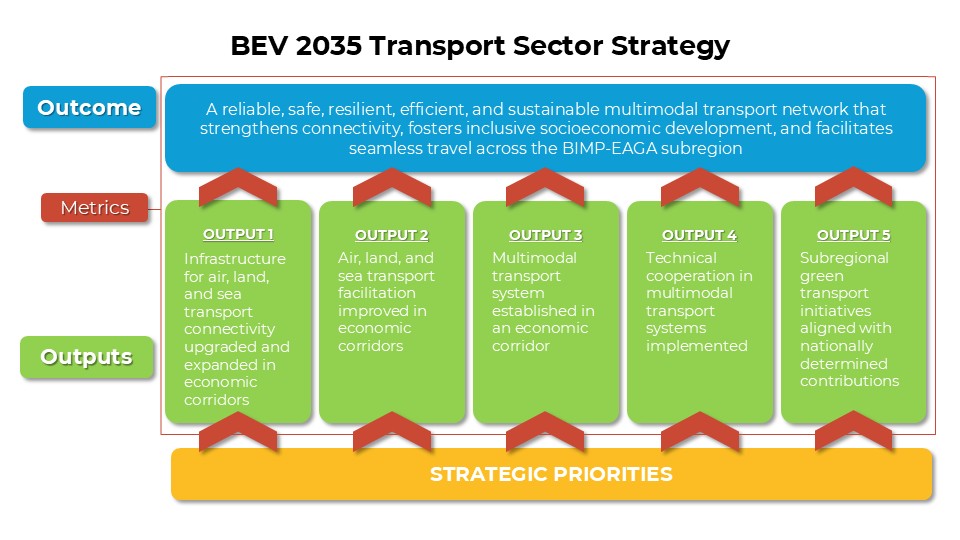
Strategic Priorities
1. Increase multimodal (air, land, and sea) transport connectivity, as appropriate, within and between the West Economic Corridor (WEC), Central Economic Corridor (CEC), North–South Economic Corridor (SEC), and East Economic Corridor (EEC).
2. Review and amend memorandums of understanding to improve transport facilitation.
3. Integrate green considerations into the development and upgrading of infrastructure and facilities at designated priority seaports, airports, and land routes.
4. Enhance technical cooperation in transport innovations.
5. Strengthen project-level convergence.